
Henrik Müller · 11 October 2026
How Crowdsourced Phenology Logs Refine Bloom Prediction Models in Online Botanical Repositories
Phenology logs collected through crowdsourced platforms feed directly into bloom prediction algorithms housed in online botanical repositories, and these records capture first bloom dates, peak flowering periods along with leaf-out timings across thousands of species. Observers upload timestamped photographs and location data through mobile applications, which then undergo verification before integration into centralized databases that track multi-year patterns. Researchers combine these entries with temperature, precipitation along with daylight metrics to adjust regression models that forecast flowering windows under varying climate scenarios.
Data Collection Mechanisms in Citizen Science Networks
Participants record observations through standardized protocols that specify exact phenological stages, and platforms such as those operated by national phenology programs route submissions through automated quality filters before human moderators approve entries. This process generates datasets spanning continents where individual records number in the millions, and algorithms weigh each contribution according to observer experience levels along with geographic density. As of October 2026, repositories report sustained growth in submissions from both temperate and subtropical zones, which allows models to incorporate broader latitudinal gradients and refine regional calibration parameters.
Model Refinement Through Aggregated Records
Statistical models ingest crowdsourced timestamps to recalibrate thermal accumulation thresholds that trigger bloom events, and machine learning layers identify anomalies where traditional climate-only predictions diverge from observed dates. Analysts apply ensemble techniques that merge historical herbarium specimens with live logs, which reduces mean absolute error in forecasts by incorporating microclimate effects captured at the observer level. Data from the USA National Phenology Network demonstrates how species-specific adjustments improve accuracy when volunteer records fill gaps in remote monitoring networks.
Integration with Online Botanical Repositories
Repositories expose application programming interfaces that pull verified phenology logs into predictive dashboards, and users query these systems for bloom probability maps updated weekly during active seasons. Backend pipelines normalize timestamps across time zones while spatial interpolation routines estimate conditions between observation points. The second image illustrates how repository interfaces display refined model outputs overlaid on species distribution layers.
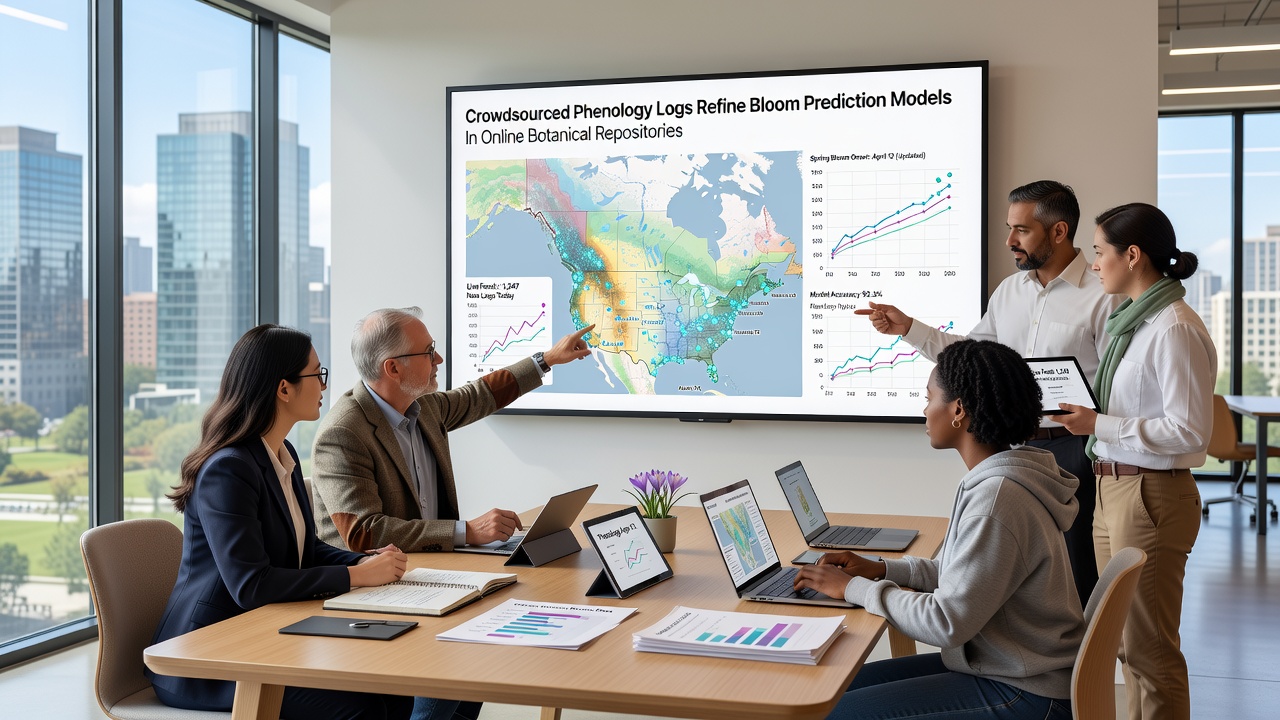
Cross-validation occurs when independent datasets from government meteorological services test model outputs against withheld observation subsets, and discrepancies trigger iterative parameter updates. This feedback loop operates continuously as new logs arrive, which maintains model relevance amid shifting seasonal baselines.
Geographic and Temporal Scaling Benefits
Crowdsourced contributions extend coverage beyond instrumented sites maintained by research institutions, and denser sampling in urban and agricultural areas reveals localized deviations driven by heat islands or irrigation practices. European phenology programs contribute parallel records that allow comparative analyses across hemispheres, while Australian networks add data on drought-adapted flora. Temporal depth increases when multi-decade observer histories establish baseline variability, which in turn sharpens detection of trend departures linked to temperature anomalies.
Validation and Error Reduction Processes
Repositories apply outlier detection routines that flag records deviating beyond three standard deviations from species norms, and flagged entries receive additional review before inclusion in training sets. Comparative studies against satellite-derived vegetation indices confirm alignment between ground observations and canopy green-up signals at regional scales. Ongoing audits track changes in model performance metrics after each data refresh cycle, ensuring that cumulative refinements translate into measurable forecast improvements.
Conclusion
Crowdsourced phenology logs supply the granular observations required to update bloom prediction models within online botanical repositories, and these updates rely on verified citizen contributions combined with environmental covariates. Continuous ingestion of new records supports iterative calibration that narrows prediction intervals across diverse species and regions. The resulting systems deliver location-specific flowering forecasts used by agricultural planners, conservation managers along with educational programs that depend on timely seasonal information.